
PVC vs PU vs Rubber Conveyor Belt: Which One Is Right for Your Application?

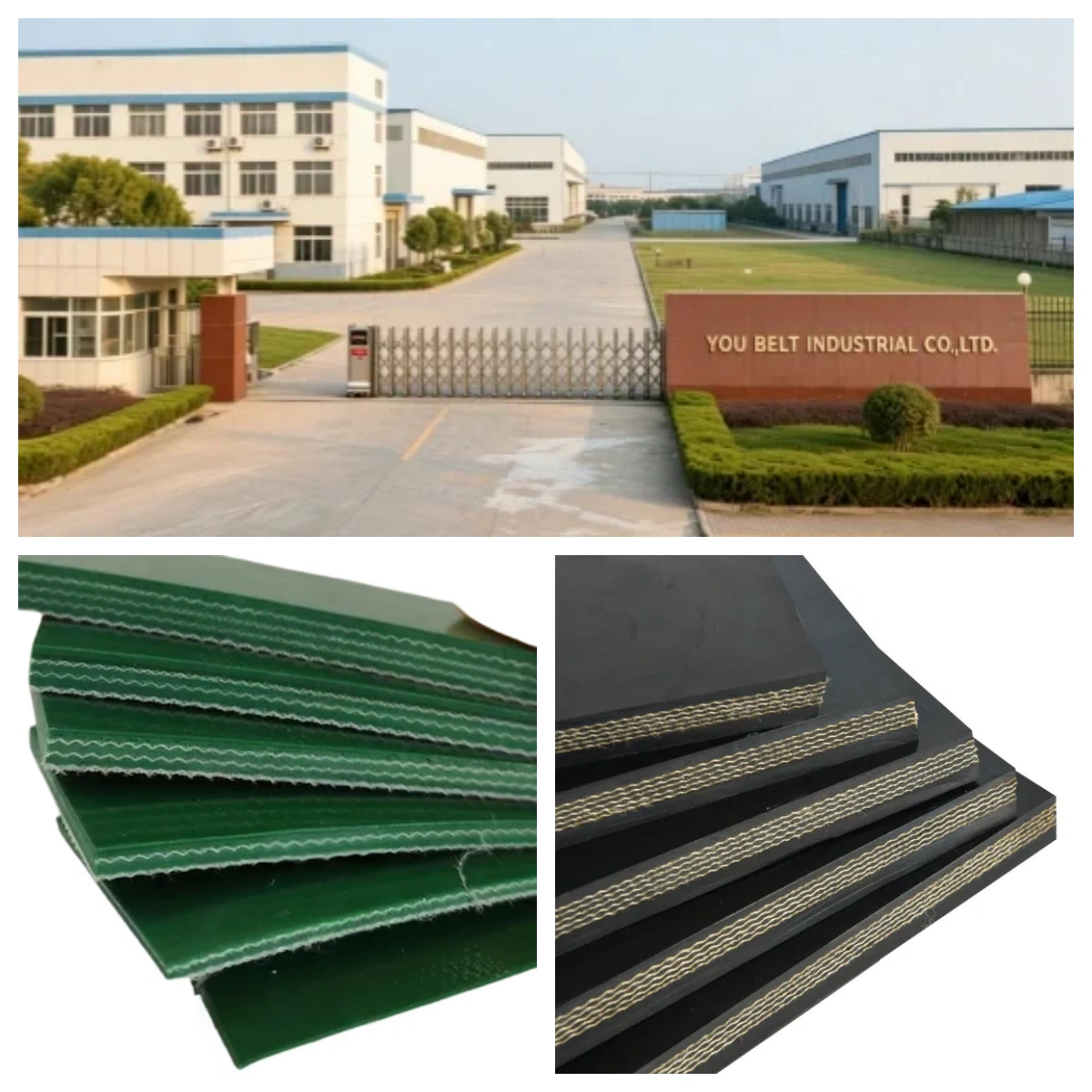
Choosing the right conveyor belt for your production line or material handling system can be challenging. With so many material options available—PVC, PU, and Rubber—how do you know which one delivers the best performance, durability, and value for your specific application?
In this guide, we’ll compare PVC, PU, and rubber conveyor belts across four critical dimensions: load capacity, temperature resistance, cleaning requirements, and cost. By the end, you’ll have a clear, actionable recommendation (including a quick-reference table) to make the right choice.
Quick Overview: PVC vs PU vs Rubber
Feature | PVC | PU | Rubber |
|---|---|---|---|
Load Capacity | Light to medium | Light to medium | Heavy duty |
Temperature Range | -10℃to+80℃ | -20℃to+80℃(peaks to +100℃) | -30℃to+200℃(special compounds) |
Cleaning/Hygiene | Fair-chemical resistant but less food-grade options | Excellent-FDA/EU compliant,easy to clean | Poor-porous,hard to sanitize |
Cost | Low to medium | Medium to high | Medium(heavy grades cost more) |
- Load Capacity: How much weight will your belt carry?
- PVC: Best for light to medium loads (e.g., packaging, electronic assembly, small parts handling). Typical tensile strength: 8–15 N/mm.
- PU: Similar load range to PVC but offers higher elongation resistance, making it better for inclined conveying of packaged foods or pharmaceuticals.
- Rubber: The undisputed champion for heavy-duty applications (mining, aggregate, bulk materials). Tensile strength can exceed 200 N/mm with fabric or steel cord reinforcement.
✅ Recommendation:
For heavy/bulky materials (stones, ores, heavy pallets) → Rubber
For light to medium goods (cartons, electronics, pouches) → PVC or PU
- Temperature Resistance: Will your belt face heat or cold?
- PVC: Works well between -10°C and +80°C. Not recommended for high-heat applications or deep-freezing environments.
- PU: Performs from -20°C to +80°C (certain PU grades can handle +100°C intermittent). Excellent for cold storage and food freezing tunnels.
- Rubber: Withstands -30°C to +120°C (special high-temp rubber up to 200°C). Best for hot clinker, foundries, or outdoor extreme weather.
✅ Recommendation:
Freezing chambers / cold stores → PU
Hot materials (>100°C) → Rubber (heat-resistant grade)
Room temperature / ambient → PVC or PU are both fine.
- Cleaning & Hygiene Requirements: Which industry are you serving?
This is a major differentiator for food, pharmaceutical, and electronics industries.
- PVC: Acceptable for general industrial use. Some PVC belts are food-contact approved (e.g., FDA), but surface can be harder to fully sanitize compared to PU.
- PU: Gold standard for hygiene. Smooth, non-porous surface, resistant to oils and fats. Most PU belts are FDA, EU 10/2011, and NSF certified. Easy to clean with high-pressure wash-downs.
- Rubber: Porous surface tends to trap dirt and bacteria. Not suitable for direct food contact or sanitary environments. Excellent for dirty, gritty conditions.
✅ Recommendation:
Food processing / pharmaceutical / cleanrooms → PU (or FDA-approved PVC if budget is tight)
General industry / dusty or oily environment → Rubber (tough, absorbs impact)
- Cost: Initial investment vs total cost of ownership
- PVC: Most economical. Low upfront cost, widely available, easy to splice and install.
- PU: Higher initial cost than PVC, but longer wear life in abrasive/clean environments reduces replacement frequency.
- Rubber: Moderate to high upfront cost (especially heavy-duty/steel cord). However, its extreme durability in demanding applications often gives the lowest cost per ton conveyed.
✅ Recommendation:
Budget-sensitive light-duty lines → PVC
Need longer belt life + hygiene → PU (better ROI over time)
Extreme conditions require heavy-duty → Rubber (pay for performance)
Quick-Reference Application Cheat Sheet
Your Application | Best Belt Choice | Why? |
|---|---|---|
Food processing(meat,dairy,bakery) | PU(or FDA PVC) | Easy to clean,oil/fat resistant,certified |
Logistics&warehousing(cartons,parcels) | Rubber or high-grip PVC | High impact resistance,good tracking |
Electronics assembly/light manufacturing | PVC/PU | Anti-static options,smooth surface,low debris |
Bulk materials(sand,gravel,coal) | Rubber | Extreme load capacity,abrasion resistant |
Pharmaceutical/medical device | PU | Non-shedding, cleanroon compatible |
Inclined conveying)packaged goods) | PU(with cleats/texture) | Better grip,higher elongation resistance |
Cold storage/freezer tunnels | PU | Remains flexible at -20℃ |
So, which conveyor belt is right for you?
Make your decision based on your primary constraint:
- If load is heavy and environment is dirty → Rubber
- If hygiene and cleaning are critical → PU
- If you need a low-cost, all-purpose belt for light-duty → PVC
Still unsure? Many applications actually use different belt types at different stages – e.g., rubber for bulk receiving, PVC for sorting, PU for final packaging.
—
Need a custom recommendation for your line?
At You Belt Industry Co.,Ltd , we specialize in supplying high-quality PVC, PU, and rubber conveyor belts for industries worldwide.
✅ Free technical consultation
✅ FDA/EU certified food-grade options
✅ Custom lengths, widths, profiles, and cleats
✅ Fast lead times (15–25 days) and low MOQs
👉 Contact us today – send your belt spec (length, width, material, application) and we’ll reply within 24 hours with a tailored solution.
Share this guide with your maintenance or procurement team. And if you found it helpful, bookmark it – we regularly update our technical blog.