
PVC vs PU Conveyor Belt: A Complete Buyer’s Guide to Material Selection

PVC vs PU Conveyor Belt: A Complete Buyer’s Guide to Material Selection
If you’ve ever been puzzled by the difference between PVC and PU conveyor belts — or worse, ordered the wrong one and watched it fail prematurely — this guide is for you.
As a conveyor belt manufacturer with 15+ years serving buyers across food processing, logistics, electronics, and packaging, we field this question almost daily. PVC and PU look similar at first glance. They are both light-duty synthetic belts, they both come in green or white, and they both feel smooth to the touch. But under the hood, they are very different polymers with very different performance envelopes — and choosing the wrong one can mean early cracking, sanitation failures, or costly downtime.
This guide compares the two materials head-to-head, explains when each one is the right choice, and gives you a practical decision framework to specify the right belt for your line.
What Is a PVC Conveyor Belt?
PVC stands for **polyvinyl chloride**. In conveyor belt manufacturing, PVC is used as the **cover material** (the outer skin) laminated to a fabric carcass — typically polyester, cotton, or a polyester-cotton blend.
**Key characteristics of PVC covers:**
- Hard, smooth, relatively rigid surface
- Excellent abrasion resistance at moderate temperatures
- Good chemical resistance to acids, alkalis, and salts
- Cost-effective: typically 20-40% cheaper than PU
- Operating temperature range: roughly -10°C to +80°C
- Available in many colors (most commonly green, white, black)
**Common applications:**
- General logistics and warehousing (incline conveyors, transfer lines)
- Package handling
- Tobacco and postal sorting
- Woodworking (where sparks are not a concern)
- Airport baggage handling
- Light-duty assembly lines
What Is a PU Conveyor Belt?
PU stands for **polyurethane**. Like PVC, PU is used as the cover material bonded to a fabric carcass. But the polymer itself behaves differently at the molecular level, giving PU very different performance properties.
**Key characteristics of PU covers:**
- Soft, elastic, almost rubbery surface
- Outstanding resistance to oils, fats, and hydrocarbons
- Excellent hydrolysis resistance (does not break down in water or steam)
- Food-safe formulations available (FDA, EU 10/2011 compliant)
- Operating temperature range: roughly -20°C to +100°C (some specialty grades to 110°C)
- Slightly more expensive than PVC
**Common applications:**
- Food processing (meat, dairy, bakery, fruit, vegetable)
- Pharmaceutical manufacturing
- Electronics assembly (cleanroom-friendly)
- Any environment with regular wash-down or high humidity
- Lines using metal detectors (PU does not contaminate signals)
PVC vs PU: A Direct Comparison
| Property | PVC Belt | PU Belt |
| Surface hardness | Hard, rigid (Shore A 75-85) | Soft, elastic (Shore A 70-85) |
| Temperature range | -10°C to +80°C | -20°C to +100°C (some up to 110°C) |
| Oil resistance | Poor — swells and degrades | Excellent |
| Hydrolysis resistance | Moderate | Excellent |
| Food contact safety | Limited grades available | Wide range of FDA / EU 10/2011 grades |
| Abrasion resistance | Very good | Good (slightly less than PVC) |
| Tear resistance | Good | Excellent |
| Flexibility | Stiffer | More flexible, easier to track |
| Cost | Lower | Higher (typically 20-40% premium) |
| Color range | Wide | Limited (mostly white, light blue, transparent) |
| Lifespan (typical food-grade) | 1-3 years | 3-5+ years |
When to Choose PVC
PVC is the right choice when:
1. **You are conveying dry, non-oily, non-food products.** Cardboard boxes, plastic containers, wooden parts, baggage, general warehouse goods.
2. **You need a very low-cost belt.** PVC is the most economical option in light-duty applications.
3. **You need a specific color for visual sorting or branding.** PVC is available in many colors.
4. **The operating environment is dry and ambient temperature.**
5. **You need high abrasion resistance in a dry environment.** PVC handles abrasive dry materials (like wood chips or aggregate) very well.
When to Choose PU
PU is the right choice when:
1. **You are in the food industry.** PU’s hydrolysis resistance and food-safe formulations make it the default choice for meat, dairy, bakery, fruit, and vegetable processing.
2. **Your line has exposure to oils, fats, or cleaning chemicals.** PU resists these far better than PVC.
3. **Your line requires frequent wash-down or operates in high humidity.** PU does not degrade in water.
4. **You operate at low temperatures** (cold storage, frozen food, cold-chain logistics) — PU stays flexible well below 0°C.
5. **You need a softer, more flexible belt** for tight pulley diameters or knife-edge conveyors.
6. **You are in pharmaceutical or cleanroom manufacturing** — PU has lower particle shedding than PVC.
Common Mistakes Buyers Make
In our experience, three mistakes account for the majority of premature belt failures:
**Mistake 1: Using PVC in oily or wet environments.**
PVC swells when exposed to oils, fats, or certain cleaning chemicals. The cover can delaminate from the carcass within weeks. If your line has any oil exposure, specify PU from the start.
**Mistake 2: Using food-grade PU in high-temperature applications beyond 90°C.**
While PU tolerates higher temperatures than PVC, standard food-grade PU degrades above 90°C. For high-temperature food applications (baking, cooking, sterilization), you need a specialty high-temp PU or silicone.
**Mistake 3: Choosing the wrong surface profile.**
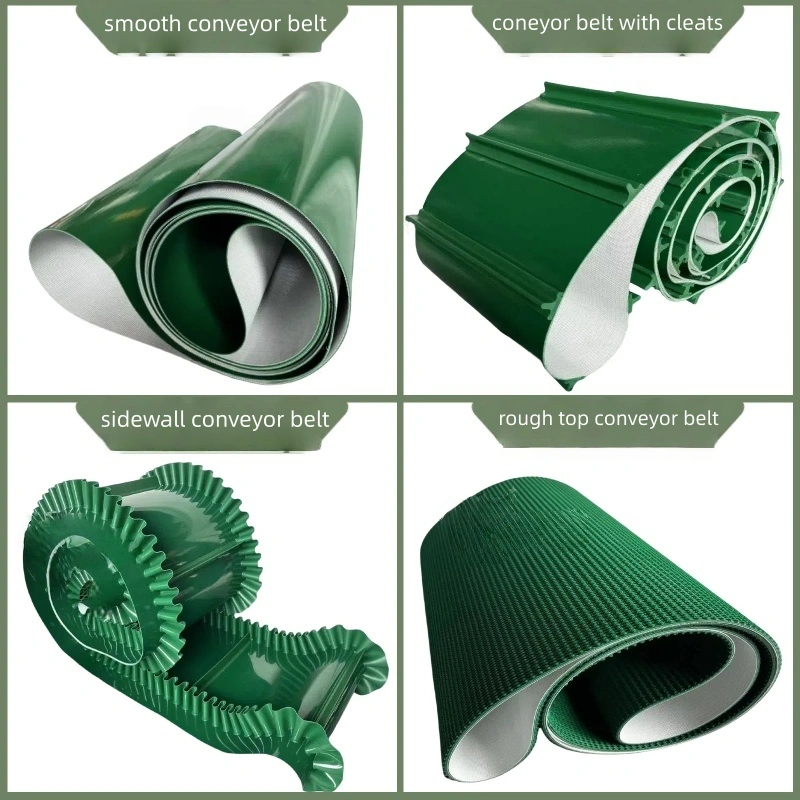
Both PVC and PU belts come in smooth, matte, or patterned surfaces. Smooth surfaces are easier to clean but offer less grip. Patterned surfaces (sawtooth, diamond, herringbone) provide grip on incline conveyors. Specify the right surface for your application.
How to Specify a PVC or PU Belt
When you contact a conveyor belt supplier, have these details ready:
- **Material**: PVC or PU
- **Belt width**: in mm
- **Belt length**: in mm (or m)
- **Number of fabric plies**: 1, 2, 3, or more
- **Fabric type**: polyester (EP), cotton (CC), or nylon (NN)
- **Surface profile**: smooth, matte, sawtooth, diamond, etc.
- **Color**: green, white, blue, black, custom
- **Food contact**: yes/no (and required certifications: FDA, EU 10/2011)
- **Operating temperature**: minimum and maximum
- **Special requirements**: oil resistance, anti-static, flame retardant, low noise, etc.
A good supplier will confirm all these points before quoting. If you do not have all the answers, ask the supplier for help — they can usually recommend a standard specification based on your application.
Why Source From a Dedicated Manufacturer?
Working with a manufacturer (rather than a trading company) gives you three advantages:
1. **Direct technical support** — you can talk to the engineer who actually built the belt.
2. **Customization flexibility** — non-standard widths, special cover compounds, custom profiles.
3. **Better pricing and lead times** — no intermediary margin.
At YouBelt, we manufacture both PVC and PU conveyor belts in our facility in Wuxi, China, and export to over 40 countries. We offer FDA and EU food-grade compliance, custom widths from 100mm to 3000mm, and flexible MOQs for buyers testing a new line.
Conclusion
PVC and PU conveyor belts look similar, but they are designed for very different environments. **Use PVC for dry, general-purpose conveying at the lowest cost. Use PU whenever oil, water, food contact, or low temperatures are involved.** When in doubt, talk to a manufacturer — a 10-minute conversation can save you weeks of premature failure and downtime.
**Next steps**: If you are ready to specify a belt, send us your line details (product being conveyed, environment, dimensions) and we will recommend a standard specification within 24 hours. Sample rolls are available for trial runs.